
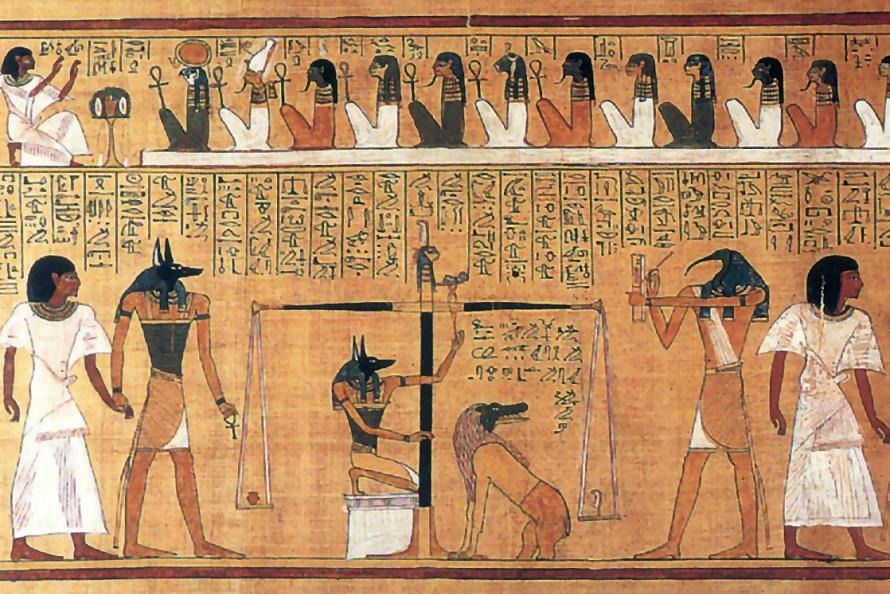
You enter the Hall of Justice, with your heart, the only remaining organ in your body, pounding. You walk up to Osiris’s throne and kneel. Your heart is taken and placed onto the scales by Anubis, the jackal-headed god. It is weighed against the Feather of Ma’at, or the feather of truth. What happens from there? How did you get there in the first place? There is so much to learn about the ancient Egyptian afterlife and the rituals and practices that help you get there.
Ancient Egyptian tombs come in a wide range of shapes and sizes. If you are a poor Egyptian farmer, your tomb might just be a pit in the ground where your body and possessions are placed. If you are a pharaoh, your tomb is a grand and beautiful many-chambered place filled with riches upon riches. Every tomb had two main parts. The chapel and the burial chamber. If you were a pharaoh, your mortuary temple, which was built in honor of your death, would serve as your chapel. The chapel was where the friends and family of the deceased would leave offerings for the deceased. The soul obviously didn’t eat the food, but they believed that the soul absorbed the life force of the food. If the deceased’s friends and family forgot to present offerings, the soul would disappear forever. The other main part of the tomb is the burial chamber, which is where your sarcophagus is placed. A sarcophagus is a wooden or stone coffin that holds the dead’s mummified body. It is usually decorated with hieroglyphs, which is the ancient Egyptian system of writing. In the burial chamber, there are also lots of burial goods like furniture, jewelry, and food. In a normal tomb, the burial chamber is usually underground, with a shaft leading up to the chapel. Aside from the chapel and burial chamber, the tomb usually also contains a false door, which is meant to be used by the soul so they can enter and exit the afterlife. The walls of the tomb are usually covered with paintings and writing. The paintings usually depict the deceased going about their daily activities. There is so much to look at inside the tomb of an ancient Egyptian.
The mummy is not the only thing that the tomb of an Egyptian holds. Tombs are usually filled with as many items as possible to make life more comfortable. There are things like jewelry, clothes, furniture, games, and cosmetics. The tomb of King Tut contained more than 80 pieces of furniture, including three adult thrones and one child-sized throne. One thing that the tombs of every middle and upper-class Egyptian have are shabti. Shabti are small dolls made of wood, stone, or metal that come to life in the afterlife to serve the dead person’s soul. Shabti did manual labor like farming, so that the dead soul didn’t have to work as hard, and so that life was more pleasant and less back-breaking for the deceased. A tomb could hold as many as one thousand shabti. There were also things in the tomb other than furniture and jewelry. One thing every Egyptian tomb had was canopic jars. The canopic jars came in a set of four, and each one held a different organ from the deceased’s body. The heart remains in the body, because the soul needs that for the Weighing of the Heart. The liver, lungs, stomach, and intestines go into the canopic jars. The lid of each jar is usually shaped like the head of one of the four sons of Horus. Their names are Imsety, Hapy, Quebehsenueg, and Duamutef. There are so many items that an ancient Egyptian soul would need while living in the afterlife.
Ancient Egyptian funerals were some of the most elaborate in the ancient world, due to the fact that the concept of life after death was very important to ancient Egyptians. The funeral of an ancient Egyptian would start at the home of the deceased. Their coffin would be carried on a sledge or by pallbearers, who are people who carry the coffin during the funeral procession. Ancient Egyptians believed that the west side of the Nile River was the land of the dead, because the sun “died” in the west. Because of this, most Egyptians lived on the east side of the Nile, and they buried their dead in the west. The body was usually transported across the Nile on a barge. During the entire funeral procession, people mourn for the deceased person. Paintings of funeral processions show people screaming, crying, tearing their clothes, and even covering themselves in dust or soot. Professional mourners are often hired to mourn for the deceased. At a funeral, the dead person usually represents the god Osiris, and two women fulfill the roles of the two sister goddesses Isis and Nephthys. The wife of the deceased usually represents Isis. This is an important part of the funerary ceremony. Some other people who attend the funeral are the lector priest and the sem-priest. The sem priest is the one who performs the opening of the mouth ceremony. During this ceremony, the priest touches the mouth, eyes, ears, and other sensory organs of the mummy with a ceremonial instrument called the adze. This ceremony ensures that the deceased’s soul is able to see, hear, eat, speak, and breathe in the afterlife. During the funerary rituals and ceremonies, the lector priest reads spells that purify the dead and join the Ba and Ka, two of the five parts of the soul. There are so many rituals and funerary practices in ancient Egyptian funerals.
Ancient Egyptian people believed that the soul had five parts. The Ka, Ba, Akh, Shwt, and Name. The Ba represents the personality. Every person’s Ba is different. This part of the soul usually takes the form of a bird with a human head. It journeys from the tomb to check on the family of the deceased, but it has to return to the tomb every day to rejoin with the Ka, the soul will disappear. It joins with the Ka to create the Akh. The Ka is the creative life force of the soul. It comes into existence at birth and is the protector of the soul. When the person dies, the Ka lives inside a portrait or statue of the deceased person. The Ka stays at the tomb and protects the mummy. It also accepts offerings from the friends and family of the deceased person. The Ka, along with the Ba, join together to create the Akh. The Akh is the third part of the soul. It is immortal and lives in the afterlife. It can assume any form and can even transform into a ghost and go visit the world of the living. The Shwt, or the Shadow, is considered to be an entity of great power. It protects the soul from harm and usually stays near the Ba. The Name is the last part of the soul. It is the living part of the person, and it is given to the soul at birth. According to ancient Egyptian culture, if you don’t have a name, you don’t have a meaningful existence. They believed that the creator god Ptah created things by saying their name. Each of the five parts of the soul has an important role to play in a person’s life and death, and the soul couldn’t exist without all parts.
The Book of the Dead was very important to ancient Egyptians. The Egyptian underworld was a complex, many-layered place, and souls needed a guide to help them find their way. This guide was the Book of the Dead. Although it is called the Book of the Dead, it is not a book. It is a collection of more than 200 chapters of spells, hymns, and treasure troves of information that will help dead souls make their way into the afterlife. Before they die, middle-class Egyptians can buy spells from scribes with blanks in them for the person to write their name. Pharaohs, on the other hand, can have scribes write their favorite chapters with color illustrations. The wealthier and higher-classed the ancient Egyptian is, the more customised and elaborate their Book of the Dead is. By the New Kingdom, the golden period of ancient Egyptian history, Pharaohs had the Book of the Dead carved and painted across their tomb walls. Without a Book of the Dead, it is almost impossible to reach the afterlife because of how much crucial information it contains. There are prayers and hymns to the gods, spells that ward off evil, and the passwords and poems that souls needed to know in order to be granted entry to the afterlife. An ancient Egyptian soul wouldn’t be able to enter the afterlife without a Book of the Dead.
The journey through the Egyptian underworld, the Duat, is long and perilous. It begins by Isis, the goddess of mothers, entrusting the soul’s Ba to Anubis, the jackal-headed god of mummification. They travel past the mountain that supposedly holds up the sky, and eventually enter the Duat. Anubis, along with the souls of the dead, travels on a barge through dark caverns. This place is called the Gallery of the Night, and its waters are filled with dangerous demons, lost souls, and enemies of Osiris. The spells of the Book of the Dead, along with the protection of Anubis, are enough to keep the spirits at bay. The souls eventually reach the seven gates that guard the afterlife, each with a guardian that they must pass. Souls must say the secret name of the guardian or recite some magic words in order to pass. After the seven gates, the souls must travel through the ten pylons, which are monumental gates at the entrance to temples or holy places. Once again, the soul must recite magic words from the Book of the Dead in order to pass. Finally, they enter the Hall of Justice, where the weighing of the heart ceremony is performed. Finally, the soul is able to enter the Egyptian afterlife, which is known as the Elysian Fields, or the Field of Reeds, where the soul can live forever. As long as the soul is remembered somehow back in the world of the living, they may live a comfortable life in the Field of Reeds, with an abundance of food and shabti servants. The Egyptian afterlife is a wonderful place, but to reach it, souls must undertake a long, dangerous journey.
Once a soul finally reaches the end of their journey, they must pass the Weighing of the Heart ceremony. This is the most important part of your trip to the afterlife. If you do not pass, you won’t be able to enter the Elysian Fields. The ceremony begins when Anubis leads the soul into the Hall of Justice, where the ceremony takes place. Inside the hall, there is a set of scales, many gods and deities, and Ammit the Devourer, a monstrous creature that is part lion, part crocodile, and part hippo. Osiris, the Egyptian lord of the dead, sits in front of the scales. He is the one who makes the final ruling during every trial. Your heart is placed on the scales and is weighed against the feather of Ma’at, or the feather of truth. Ancient Egyptians thought that the heart was the organ that did all of the thinking, and that the brain was just stuffing meant to keep your head from collapsing. When you are mummified, the brain is pulled out of your head and is discarded. That is why your heart is weighed against the feather instead of your brain. In the Hall of Justice, there are also 42 judges. Each one must ask you a question: whether you have committed a specific sin. Every time the soul responds to a question with a yes, the heart gets heavier. By the end of the trial, if the heart is still lighter than the feather, the soul may pass into the afterlife. If the soul is heavier, Ammit devours the heart, and the soul is sent to oblivion. The weighing of the heart ceremony is the final test to enter the afterlife, and if you fail, there is no going back.
The Egyptian afterlife is a vibrant, wonderful place, but you must undertake a long journey to get there. You must prepare yourself in the living world, and you must be brave and knowledgeable during your journey through the underworld if you wish to reach paradise. There is so much to learn about the Egyptian’s idea of life after death.
Bibliography:
Print:
Millmore, Mark. Imagining Egypt: A Living Portrait of the Time of the Pharaohs
Pemberton, Delia. Egyptian Mummies: People from the Past
Weekes, Kent. Valley of the Kings
Digital:
Ducksters. ducksters.com
Encyclopedia Britannica. britannica.com
Gale in Context: World History. go.gale.com
National Geographic. nationalgeographic.com
 Rishabh’s Blogs