

AI generated image
The American Revolution was a war between England and its American colonies. In the early 1600s, English explorers sailed to what is to become the United States and established thirteen colonies. The thirteen colonies were split into three parts, the New England Colonies, the Middle Colonies, and the Southern Colonies. All thirteen colonies were on the eastern side of America, and there were other parts of North America occupied by other countries or belonged to the Native Americans that would later become parts of the United States as well.
THE BEGINNING:
At first, the colonies and their mother country, England, got along well. The colonies provided raw materials like lumber, crops, and metal. But England had lost a lot of money and soldiers in the French and Indian war, and the parliament needed money. The parliament started putting taxes and other acts on the colonies. For example, there was a sugar act, and a currency act which stopped the colonists from using their own paper money, because it wasn’t worth as much to English traders and merchants. They even passed a stamp act which needed official papers to be stamped for a fee. The colonists were angry about the taxes and fees put on them and wanted to put a stop to it.
The colonies were starting to become more independent, they were building and expanding, making more towns and plantations. (A plantation is a large field where crops are grown by people and looked over by someone. Most of the plantations in the colonies were in the Southern Colonies, because it was warmer there). Sometimes the Native Americans would attack towns, and England didn’t need to send help anymore. The colonists were managing it fine. Some of them were starting to have ideas about independence. They started a congress with representatives from all the colonies.
BOSTON TEA PARTY:

Edward Gooch/Getty Images
The colonists were mad about the taxes, and they wanted to act. There was an East India Trading Company that had a humongous storage of tea. Thomas Jefferson and many others disguised themselves as Native Americans and snuck into a ship from the trading company. They crept into the storage and carried the crates of tea out onto the deck. There, they tossed the crates out into the water and ran away. This event was known as the Boston Tea Party. This act of rebellion was pretty cool, but I don’t like how they framed the natives by disguising themselves as them. The British weren’t pleased, and as payback (literally), they stopped any ships from entering or leaving Boston until the citizens pay for the tea they destroyed.
START OF THE WAR:
The colonists weren’t happy, and they began preparing for war. Representatives from all the colonies except Georgia came together and united. Of the many representatives, there was George Washington, Samuel Adams, John Adams, and Thomas Jefferson. The spies of a British general, Thomas Gage, found out about it, and the British prepared for the worst. King George, the king of Britain at the time, declared Massachusetts as a state of rebels. General Gage’s spies said that the colonists had stockpiled a bunch of military supplies like arms, gunpowder, and medicines.
General Gage had a plan. He brought hundreds – maybe thousands – of men to Massachusetts. In the middle of the night, the British soldiers paddled on boats across a river and began marching towards the location of the stockpile (Concord, which was a town near Boston). But the colonists were prepared. Apparently, someone had tipped them off about the attack. American patriot Paul Revere set up a signal that notified the American soldiers whether the British were going to travel by land, or by sea. As soon as Paul Revere saw the British men marching towards him, he jumped on his horse and galloped to Lexington, a nearby town, and warned Samuel Adams and another person, John Hancock, who were waiting there for him. They marched through the towns and had no problems until they got to Lexington, where they were stopped by soldiers known as minute men.
Minute men were soldiers who are always prepared for an attack by always having their uniform and rifle out. If there was an attack, someone would ring the church bell or sound a horn, and the minute men would throw on their uniforms and run outside in a minute, giving them the name minute men. But the minute men were highly outnumbered. The British men told them to surrender and lay down their arms. Most of the minute men were intimidated by the British troops and walked away. The minute men had surrendered. But then, someone’s gun discharged. It might have been an accident, or it might have been intentional. No one knows who did it. But the outcome was the same. As soon as the British heard the shot, they began firing at will. The minute men had no choice but to shoot as well. Eight Americans were killed during the incident. Those were the first shots of a long war.
THE WAR:
General Gage and his men were tired and weary and were relieved when reinforcements came from England. More colonists had decided to join the revolution. Almost ten thousand men showed up, ready to fight. The British parliament had sent hundreds of men, uniforms, and supplies. The Americans didn’t have as many resources. Some of the men had muskets. Some brought scythes or sickles. The war lasted about seven years, and there were many battles fought in those seven years. It would take too long to write about all of them, so I’ll just write about the important ones.
The American army knew that they wouldn’t be able to fight the British without cannons. One of the leaders, Benedict Arnold, led an expedition to a fort known as Fort Ticonderoga. The men planned to surprise attack the fort and got the jump on them. The revolutionists demanded surrender, and the fort’s men weren’t doing very well. The fort was surrendered to the Americans, along with many guns, boats, cannons, and other supplies. This was great for the American army, for they got more guns, and now have some cannons.
The same day the fort was captured, the Continental Congress met in Philadelphia. Not everyone was convinced that they should separate from Britain yet, but one big outcome from that meeting was that George Washington was officially appointed General of the army. Another thing that happened at that meeting was that it was decided the army would be called the Continental Army.
THE BATTLE OF BUNKER HILL:

Painted by Don Troiani in 2000, oil on canvas, on loan from Mrs. Richard Ulbrich.
The British Parliament sent boatloads – literally – of supplies to the army in America, along with three new generals. The Americans heard that the British were planning to attack their camp from the high ground around it. The Americans decided to make their move first. They all went to the highest hill in that area and fortified it by building walls of dirt and hay bales around it. When the British came to attack, they found the Americans high up on the hill. The British fired at them with heavy artillery, but the Americans were too high. The British were disciplined and trained, but the Americans position was too good. The British soldiers climbed up the hillside repeatedly. Every time they got to the top; they met the American soldiers’ guns and fell to the bottom again until almost half their men died or were injured. Eventually, the Americans ran out of bullets and retreated. Technically, the British army won the battle. But there were so many casualties that it was more like they lost. In fact, they lost so many soldiers that General Gage was fired and replaced by General William Howe.
THE DECLARATION OF INDEPENDENCE:
The Continental Congress decided to make one more peaceful request for independence. They had Thomas Jefferson write a document that was called the Declaration of Independence. Jefferson spent many nights working on the document. When he was finally done, the Congress put copies of it all over the colonies.
WINTER:
Winter had arrived, and things weren’t looking good for the Americans. A lot of men were almost done their time in the army, and their supplies were running low. Most men were just looking forward to going home. They made a camp and lay low for a while. Washington knew he had to do something, or everyone would leave.
THE BATTLE OF TRENTON:
On Christmas, under the cover of darkness, they attacked the group of German soldiers hired by the British called Hessians in Trenton. If the attack failed, Washington’s small force would be gone. The Hessians were not very prepared. They thought that the Americans were weak, and that no one fought in the winter, anyway. The Americans were able to catch the Germans completely off guard. The Americans captured about 1,000 prisoners and lots of supplies and arms.
RECAPTURE OF FORT TICONDEROGA:
The victory gave the army some spirit, and new soldiers came to join the ranks. They made a winter camp in New Jersey, where they would raid and attacked the British a few times, keeping them on edge. Meanwhile, the British were formulating a plan to shut down the rebellion once and for all. They knew that the biggest troublemakers were the New Englanders. They decided that if they got rid of the rebellion in New England, the other colonies would give in. The plan was that one British army would come from Canada down to the east side of Albany. Meanwhile, another army would march from the west side of Albany. They executed their plan in the summer. The British climbed up a hill right next to Fort Ticonderoga, the fort the Americans captured earlier in the war, and set up a ton of heavy artillery and guns. When the Americans saw the cannons and British men, they quickly evacuated, and Fort Ticonderoga was in British possession again.
OTHER BATTLES:
There were many other battles fought during the revolutionary war, including the battle of Brandywine, Germantown, and Monmouth Courthouse. Sometimes the British won, sometimes the Americans. The British were ruthless, marching right through the villages, burning their crops and destroying homes. Then, something great happened.
THE BATTLE OF COWPENS:
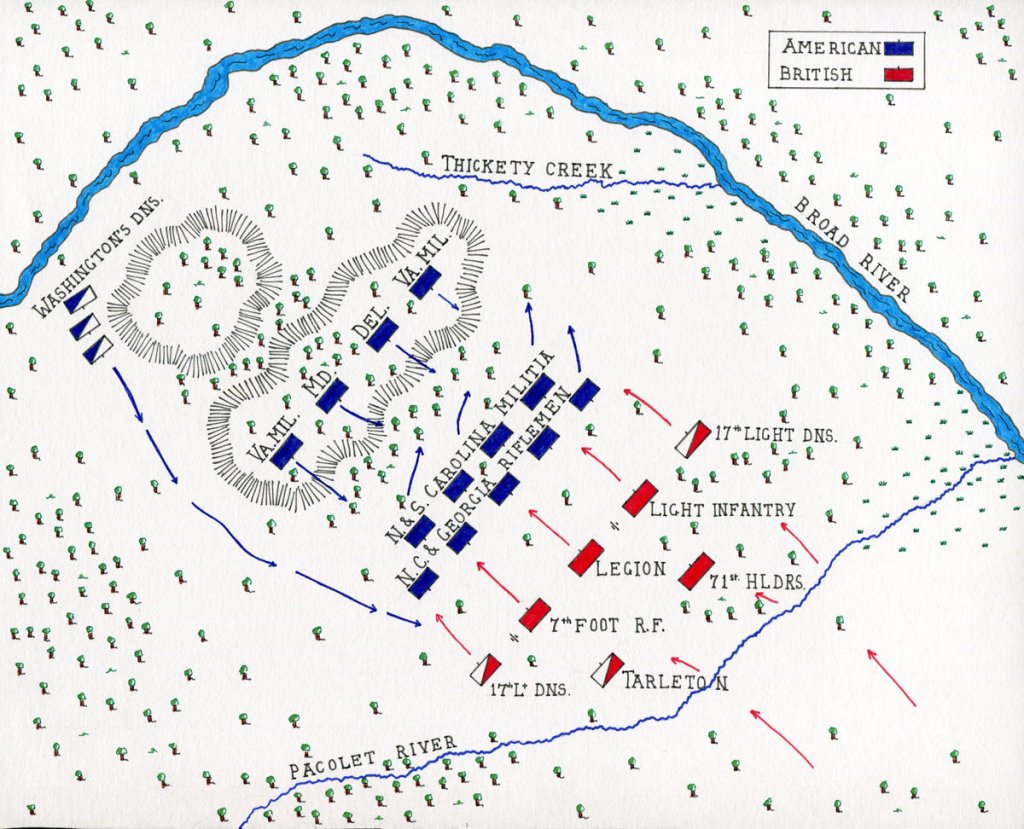
Map of the Battle of Cowpens on 17th January 1781 in the American Revolutionary War : map by John Fawkes
Things weren’t looking good for the Continental Army. They didn’t have many men at all. Washington sent General Nathanael Greene to the South Carolina where the British and Americans were fighting. Most people say that when you don’t have a lot of men and are fighting a large enemy, don’t split up. Greene threw that idea into the trash and split up the exceedingly small army. He thought that they might be able to defeat the British step by step. One group camped near the South Carolina border, while a force of six hundred soldiers marched to the west under General Daniel Morgan. Greene hoped that the British would respond by sending a detachment against General Morgan and his force. The British took the bait, sending one thousand men to stop Morgan. When the British attacked, Morgan was prepared with a cunning strategy. He split the army into three lines. In the front were sharpshooters. In the second line were militia, regular people who were hired in the army to supplement the military force, and the last line was made up of Continental soldiers and cavalry – men on horses. These are the orders that Morgan gave each line of men:
Sharpshooters – Shoot and then run to the back.
Militia – When the sharpshooters run back, shoot three times and then run behind the sharpshooters.
Continentals and Calvary – When the militia run back, attack the British.
The sharpshooters shot, and some British men fell. When the militia shot, some more men fell. When the militia ran back, it looked like fleeing to the British in the smoke and confusion of the battle. The British pressed on, only to find a bunch of Continental men and cavalry. The British have fallen for the trap. Every single soldier was captured.
The Americans achieved a victory, but the war wasn’t over yet. They fought more battles and lost many of them until there were hardly any soldiers left. The Americans had an alliance with the French, and together, Washington and French commander Comte de Rochambeau planned an attack. There were two army encampments. One under General Cornwallis in Yorktown, and another under General Clinton in New York. French admiral Comte de Grasse, along with three thousand other men sailed on a fleet of 28 toward Chesapeake Bay. If they could hold Chesapeake Bay, then Cornwallis could not flee by sea, and no reinforcements could come to help them. If the Americans and French could move quick enough, they could surround Yorktown. But first, they needed to distract Clinton so he couldn’t come to Cornwallis’s aid. Washington tricked him by marching his army to New York and having them build encampments and brick ovens, as if he were planning a siege on New York. He had officers ask known loyalists for directions far away from their real destination. He even planted fake secret messages with spies. Then, Washington and Rochambeau marched back to Yorktown. Their plan had worked. Clinton was sure that the Americans were going to attack New York. Admiral Grasse had met up with a British fleet of twenty ships off the coast of Virginia. For 2 hours, their cannons boomed until the severely damaged British ships sailed away. Grasse had control of Chesapeake Bay. Washington and Rochambeau quickly moved into position. They dug zigzag trenches and set up artillery around Yorktown. Cornwallis knew he was in trouble. He was relieved when General Clinton sent word that help was on the way. But Cornwallis was not sure that he could hold the Americans long enough. The British were outnumbered nearly two to one. The French and Americans Bombarded the town with heavy artillery. The British guns shot back and the battle raged for hours. The Americans kept on going, sending mini attacks on the Fortifications. Inside Yorktown, supplies were running short. The Briths tried to make a midnight escape but failed when a huge storm swept in. the Americans continued bombarding until eventually, the British sent a drummer boy with a note from Cornwallis to Washington. The British were ready to surrender.
A NEW NATION:
Peace had finally arrived, and it was time for the congress to create a government. The congress debated, argued, voted, and then did it some more until they finally decided on a government. There were three branches of the government:
The Legislative Branch: This branch was made up of the congress, and would be able to tax, make laws, and declare war.
The Judiciary (Supreme Court): This branch would decide on disputes between the states. It would also decide whether any laws went against the principles of the Constitution.
The Executive Branch: This branch would administer the government. Its leader would serve as commander in chief and make treaties.
Along with those three decisions, there were about a billion more things for them to decide. Making a whole government was hard work! Eventually, they figured it all out, and an anonymous vote appointed George Washington as president. There were kinks in the system, of course. But they figured it out. They had a group of writers write it all down and finally, it was time to announce it to the public. One at a time, they signed the document and announced it. But would the public agree to it? Many had opinions, but most agreed with it. Many people were surprised that the congress had come up with a whole plan for their new government. In the end, the constitution was agreed to, and America officially became a country.
THE END
 Rishabh’s Blogs